
SERVE THE SONG, ENRICH THE COMMUNITY
The Proving Ground is a studio with a vision
BY MAYTÉ ANTELO-OVANDO ON JANUARY 13TH, 2026
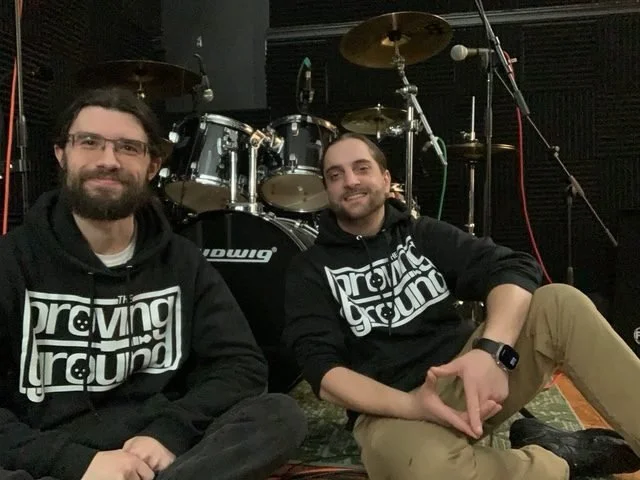
You know how when you talk to people about something or someone they love they suddenly sit up straighter, remember things they thought they’d forgotten, and share their experiences with a sparkle in their eyes? There’s so much expressed joy that you can’t help but smile as you listen! That’s what happened when I talked to Dylan Titus of Titus Compositions (from Pawtucket), and Erik Gharaee of Fungal Records (from North Providence), about their recording studio, The Proving Ground. While Palmslow (one of their clients) rehearsed in the band room (formerly a math classroom!), Dylan and Erik shared that they seek to set themselves apart by being an unconventional digital recording studio whose goal is to “serve the song” and “amplify the authenticity” of the people who walk through their doors. They want everyone to leave their sessions “feeling heard, supported, and proud of what they made,” whether it’s their first or “hundredth” time recording. The studio’s name was inspired by a saying Erik heard, “The biggest room in the world is the room for improvement.” Dylan, meanwhile, shared that the Proving Ground wants to help people record “the song in their heart… their inner artwork.” Read on to find out how they do this in a recording studio that has a living room, is housed in a castle, and was once a high school (I know it sounds unlikely but it’s true, I promise!).
Mayté (Motif): How did the Proving Ground get started?
Dylan: I’d always been recording in my spare bedroom, or my bedroom, or wherever I could. I helped produce How’s About Charlie’s (Providence-based folk band) last five releases in my old apartment. But then my partner and I were forced out of that place, and moved close to this area. As we were walking around I said, “Oh look at that! My old high school!” This building, the Pawtucket Armory, was the Jacqueline Walsh School for the Performing and Visual Arts. Shout out JMW! So I said, “Let me show you my old school,” and as we were walking on the third floor a door opened up and a gentleman stepped out and said, “Can I help you?”
Erik: “Dylan, we’ve been expecting you!” Ha!
D: It turns out he had access to the armory tower, and we ended up shooting the music video of the How’s About Charlie song that I’m the most proud of, “The Tower,” on the roof, in the tower, and in the stairwell. So the building was back in my consciousness again after ten years plus of being out of high schoo -l- and then I saw that this space was available and thought to myself, “It might be time for a studio.” And we – Erik and I – had rekindled a friendship back then.
E: That’s what I’m trying to remember. Were we talking much before we had the idea to rent here? Because I had a studio that was like garbage. It was just on the ground in a basement.
D: Yes, we started really talking again because we both had parents pass away. Your mom passed around the same time my dad did — and that brings people together. And to bring it more full circle, after I graduated from this high school I was in an emo metal band (I found the killer) for all of two months and we rented the rehearsal space that Erik ended up in!
E: I used to deny that this [he gestures around the studio] was possible. People would tell me, “You’re renting the worst place imaginable.” And I’d say, “Yeah, but it’s the only place for rent.” And everybody would say, “No, you’ll find something better one day.” And then Dylan called.
D: We moved here in March 2024, and soft-opened two months later-ish. We were barely set up when we had our first clients.
E: It still felt like we were going through the motions just to get the practice of having this place at our disposal. I feel like this year we’ve been in business.
D: This year we’ve got shirts!
M: Who was your first client?
D: Our very first client was Alex Walsh, we did a song called “Dignity.”
E: She was an open-mic regular at the Parlour (where Erik runs monthly karaoke alongside Julie Rhodes, musician and Motif events coordinator).
M: How do you recruit your clients?
E: Music venues and just being in the community of live musicians.
D: Propaganda I think is effective, begging, there’s a lot of hypnotizing, ha! But really, after Alex came in, our first major work on an album came from Slow Boat Home and longtime friend Scott Southgate and his wife Christine, who put their trust in me. And having the connection I have with How’s about Charlie, doing those songs has seemed to really give me some credence in the music scene, Dennis Emsley came in (from Slow Motion Parade) after hearing about us through that work as well.
M: Working with them gave you some legitimacy and it all came together at the right time, like you manifested it.
D: I feel like it did yeah, especially that song, “the Tower.” And isn’t that what it’s supposed to be? From tarot?
M: Yes, the tower is meant to be about radical changes happening, recognizing that for something new to be created what came before has to be destroyed.
E: In terms of recruiting, there’s a lot of cross-promotion. If Dylan is working with artists, he can ask, “Do you need anyone to provide a sound system for live shows?” (which Erik does). Then when I’m out with a band I can say, “Is any of this music recorded? I can send you to a producer (Dylan) who can do that for you.”
D: You’re in the prime fisherman’s position, to catch clients. I’ve really been blessed by friends that have taken a chance on me, on us, like Mary McAvoy. Morgan Johnston put together a musician’s support group and that’s where we met Mary. She did a song on The Voice, a cover of Radiohead’s “High and Dry,” and she said she wanted to do a full version. We recorded that and a cover of Springsteen’s “Dancing in the Dark.” Then my friend William Hall at Reel 58 had the random idea of wanting to make a music video for it, and we shot an amazing video here.
M: What are the services at the Proving Ground, and what are your roles?
E: I’m the live sound or recording engineer, and Dylan is the mixing engineer. I take a sound and make it as good as it can be until it is recorded. And then Dylan takes a recorded sound and makes it as good as it can sound for the final product.
D: Full disclosure, your job fucking terrifies me because you react in real time, whereas, if there’s feedback or something, I can always go, let’s pause, let’s rerecord that. But if you get feedback live, that’s baked in there forever.
M: You have to respond on your feet.
E: It’s just practice. And he’s got more practice in the studio. We have different types of intuition and abilities.
D: Yeah, I can think on my feet in terms of knowing when a recording is done. I hear it the second a note is played. I know that this is the whole take, or that 70% of this take is usable, 30% we’re gonna have to cut, and I know what take to call back to — that’s how I consider myself a producer. Other producers probably wouldn’t consider me one though.
E: They’re not here right now!
D: Ha, yeah! So my job is producing, arranging, composing — and services we provide: live sound which Erik excels at, and recording and production services, which are more my end, where artists will come in having a song in their heart and we will help get that song out and create a final product that they can release to the world. I’ve done everything from helping people take their lyrics and turn them into a song, to burning songs on to a CD for them to give to their families for Christmas gifts.
E: And we also have general rental of the space, or a room.
D: Yes, we have a band room that we offer as a rehearsal space, and we can also record your rehearsal.
E: We do special events too! Your mom hosted a game night here, a dozen people can come in and have a wine tasting, an art show, a movie night. We have high ceilings and a lot of walls. You don’t have to be a band that wants to practice to use our space.
D: We’ve also had bands just rent the space to write, not even to practice, just to sit with an acoustic guitar and a piano.
M: What would you say is the philosophy behind the Proving Ground? Is it about proving something?
E: It’s about improving something.
D: And improving requires you proving yourself. You gotta prove that you’re ready for improvement. I often feel like I’m a fraud — I have imposter syndrome pretty regularly, and I think, “What am I doing? This is what I record with — this $400 box?” People ask what I use for a board and I don’t have an answer. This is not your standard studio where you walk in and there’s a mixing board and glass in front of the artist, and you stand on the other side.
E: With a big rack of analog gear.
D: Exactly. If this was a traditional studio I would have more sound monitors and racks full of ins and outs and signal processors. But, basically, what’s going on in the recording booth comes straight clean into where I’m sitting (a separate room).
E: We’re a digital studio. We went to school for digital production. This is what we’re suited to do and we’re just doing it.
M: You’re taking a chance on each other, on your studio, and allowing for people to do the same with their art.
E: And we all have the same fear of making art in general: “Is anybody going to like this?”
D: Yeah, I’m bearing my soul!
E: And then there’s that magic of ‘they do like it!’ And it doesn’t matter how it was made at that point. If the work speaks for itself, it has merit.
M: Then there’s nothing to prove!
D: Yes! And you know, I have this imposter syndrome, but I’ve yet to have one client leave unhappy.
E: No bad reviews on google yet!
D: Thankfully, so for you readers out there, feel free to leave us a preemptive Google review, please.
M: Tell me about your training. What if I’m a kid and I want to do this, how do I start?
E: I feel lucky that I started as a musician. And we both went to New England Tech.
D: That’s where we met. Even though I would recommend not going to college for this, we were both in school for audio/video production. I would say if you really want to learn, reach out to a studio, see if they need help, see if you can spend a day there. Learn on the job, actively.
E: College did give us a good idea of certain industry standards. Your college professors are people that can tell you things a book can’t, basically.
D: We have a band here right now, practicing, and I just tried to do my best to do that, explaining that we’re going to be in the other room, but we are fully available to them. I set up a tablet with everything they need to mix their own session and made sure that they knew there’s water, tea, and snacks available. There’s also a fake fireplace and a Christmas tree — cozy as can be. We do a lot to make sure that clients are cozy. I find that goes a long way with helping them make their music and make their art. I think that’s why Palmslow keeps coming back, they’ve said, ‘this place is way better than that other place.’
E: We wanted to compete with other practice spaces. I found the closest spot and looked at their prices, aiming to match them. But then we realized certain things we have that give us an advantage and it’s been worth increasing our price for — I’m okay with that because I know our space is special. Most of that difference is the immersive comfort of having the living room next to the band room.
D: And you’re the only band here, where with other places you may or may not hear people coming from other rooms.
M: Right! Which is typical in many practice spaces, like in Boston for example.
E: I want to get bands from Boston, kids in college there — everybody that could rent this place for a whole day just to get started.
D: Bands that might not want to pay Boston-based prices.
M: Part of your future vision is expanding outside of Rhode Island.
D & E in unison: Yeah!
E: Also, I’d add that we help our clients by being hands on and having a no judgment zone. We’ve had clients cry to us — just feeling so comfortable they weren’t expecting it.
D: Literally crying to us.
E: And they make us cry too.
M: How do you make your clients comfortable?
D: We do a lot to make sure that clients are cozy. I find that goes a long way with helping them make their music and make their art. We had an artist, Tracy Chevrolet of Ski Bunny, who had recorded somewhere else, and she said that they were comfortable doing the instrumentals there, but that they didn’t feel comfortable doing the vocals.
E: When we met Tracy, they were performing in costume, and when they showed up to record, they asked if they could go change into it, and I said, “Of course.” That was part of the creative process for them so they wanted to include it, and that might have been something that they felt uncomfortable doing at the other studio.
M: I saw Tracy recently and asked about that experience, they said that recording the vocals was the best part and that you gave them a safe place to deal with emotions. “I’ve been in other places and have felt pushed, and that tenses up my vocal chords. I was so relaxed at the Proving Ground. I even had candles in the booth with me.”
D: I find that the cozy feel goes a long way in helping people.
E: And I think you and I have a natural tendency to give people some emotional consideration.
D: And one of the benefits of the layout especially is that the vocal booth is on the complete other side of the studio; you are as far from me as possible. So you can hear me in your ear, but…
E: You’re in outer space.
D: Indeed, again, a studio with room to grow. It’s far away so you’re not being observed through the glass. I think there’s a benefit to not being able to directly see them and just knowing that there’s a friendly guiding voice there for you.
M: What makes you a friendly, guiding voice?
D: Trying not to be an asshole when people are recording, that’s not a good way to get good takes out of them — saying — “That sucked!”
E: Or if someone says like, “Can we try it this way?” and you say, “No, we’re doing this, just keep doing it,” that’s not okay. It’s their money, it’s their time.
D: I want to stress I’m not going to milk your time for money. I could easily go, “Yeah, let’s do another take!” We can sit here and do it for hours, because it’s more money in my pocket. No. I’m going to call it when it feels right. If you knock it out on take two, we’re done. If I feel like we need 17 takes, then we do it. We serve the song, and that’s one of the things I keep saying to artists.
E: Did you come up with that? I love that.
D: I mean, I’m sure I didn’t actually come up with it but it just came to my mind, when I said it to a client they lost their mind. They were like, “Yes, serve the song!”
E: Isn’t that what a musician does when they play?
D: Well, not always, some musicians serve their ego.
E: Oh, I’m saying ideally.
D: Ideally, yes. I’ve helped artists trim away some things. Saying like, “Hey — I know you like this, but it’s not serving the song. You keep the idea, you can always come back to it, but for this song, it doesn’t work — let’s find what does.”
M: It’s about serving the artistic process towards whatever the outcome is…
E: And it’s about community — helping each artist blossom so that we have a lovely garden of culture here. There’s a studio, Big Nice — and they have us outdone in every way. But we’ve shared clients. I recently saw Brad, who owns the studio, walking down the street and I stopped him and said, “Hey, quit stealing clients from me! Ben Shaw, (who relies on Erik for live sound), is recording with you.” And while I’m saying that I’m standing with my friend Shamar Talley, who has recorded at Big Nice, and Brad goes, “You’re stealing clients from me!” And then we both laughed. What we’re really doing is enriching the community, I think that’s our philosophy.
D: Serve the song, to serve the artist, to serve the culture and community. You have to do what best represents you, because in reality becoming an artist requires spitting out a bunch of ideas that don’t work, and editing. I have thousands of ideas and 998 don’t work — that’s part of the production process. We really hone in and whittle these ideas down, to lift you up as an artist, which is going to lift the community up as a whole.
E: And anyone who gives grants out if you’re reading this, that’s us! We’re not doing it for the money, but we could sure use it.
M: Talk to me about the diversity of your clients.
D: Ferns and Fiddleheads might be our youngest band, in their 20s (a duo that recorded two EP’s in 2025 at the Proving Ground, their most recent released on December 30). We’ve had clients of all ages, as old or as young as 70. We’ve had artists of different ethnicities, sexual orientations, and everyone here has felt comfortable to be themselves. Our building is also accessible, so there’s nothing stopping somebody in a wheelchair or with diverse mobility needs, from coming in.
E: I would like older and younger folks to know this place is accessible to them. A retired gentleman showed me recordings he did with a band in the ’70s, and he said, “I have all the tapes from these recordings — can we remix them?” And I told him we could digitize that, remix it, and make it sound better than just your average demo recording from back then.
We’ve also had kids snooping around. They walked into our studio [once] and I stood up and said, “Can I help you, gentlemen?” And they said, “No, wrong room!” and ran. We followed them out and they asked, “Was that a real studio? We record our hip hop songs.” We told them they could do that here, and we could show them how to improve the quality too. That feels empowering to me.
D: I need to start going to more schools and talking to music directors. I want to talk with classes and say, “IIf anyone here is set on writing a song or has one you want to record, come to our studio.” A place like JamStage was important for me as a kid. There’s literally a picture of me on the wall, 15 year-old Dylan.
M: What was important about it for you?
D: Having a place to go to play music with other people. As a kid who went to a music school that was important for me — not only making music here, but there too. My mother brought me there for lessons. I want the same thing for youngsters that have music in their heart. We could easily host lessons here.
E: You could have players in here too. In my class at Lincoln High School, the jazz band was like 15 kids; any music teacher that has a band about that size — why not come here, record and show the kids the process — like a field trip?! And I think it helps us that this building was a school. We’re not taking them to some weird, sketchy studio.
M: They’d be coming to an armory, a castle! It’s definitely not typical.
E: Yeah, the number one thing I say about this place is that we lucked out, this is what we needed and it’s what we got.
D: People are always blown away when I say it’s a recording studio in a castle. And when I say it was my old high school it usually endears them to the place a little bit more.
E: Somebody asked me once what this classroom used to be, and you told me, wasn’t it history?
D: This was calculus, the living room was history, and the band room was math.
E: They walked in and asked, “Which classroom was this?” And I assume you were like, this was the history room. And they said, “Now you guys are making history here.” And I thought, “Wow.”
M: So what would you like to see in the next year for the studio?
D: One year from now I hope that we’ve recorded at least another album and another EP. I hope that we’ve had ten new artists, and I want five of them to be bands. I think these are feasible goals. I want to be able to start putting a real stamp on the music scene in the area and to hear our clients say, “We recorded at the Proving Ground!”
E: I hope for something similar. I hope they record their practices and that at least three of them say, “Hey, you guys want to come here to record?’ And then that turns into, “Hey do you want to have Dylan edit our music video here?” I hope it blossoms in that way.
D: I want to strengthen our relationship with the photography and piano studios in the building, and to strengthen our relationship with the community as a whole. We were talking to John Fuzek about possibly doing a booth at the Folk Fest and having outreach there. And more merch in the new year!
E: We should send a packet of merch to the Pawtucket mayor’s office or something.
D: Yeah! And we should send something to David Morales too.
M: What would you say is most meaningful for each of you about doing this work?
E: I’ve told Dylan many times that I wouldn’t do this with anyone else, so it means a lot that he is a part of it for me. That’s the first thing that came to mind.
D: Thank you, and same — that means a lot… For me, one of the most meaningful things is that I’ve never been a great songwriter on my own, and this gives me the opportunity to help people craft songs in their entirety. I get to see a song take shape and most of the time with that, I get to see somebody’s eyes light up. I had a client come in and say — “I want to record this song,” and she asked me for just vocal and guitar stems. I told her the song was really good and that we should add some harmonies to it, some oohs and aahs — and she agreed. I noticed that her eyes lit up a little bit more when it got to those harmonies, and it just made me feel so good that I got to facilitate that experience.
E: You got to serve the song!
D: Exactly. She had a song in her heart, and she came in with a bare minimum task, and we overshot that by like 1,000%. I got to see her joy.
E: I remember your joy over being able to tell me the story. You said, “Dude, we had a client and the best part was that [moment]. I don’t want to do this for money, I want to do this for that feeling that we shared.” Money can’t buy that.
M: You serve the song and amplify it. And there is something that you’re creating in the relationship with your clients that’s allowing them to do more.
E: You used the word amplify, and I was gonna add that part of the mission of the Proving Ground is letting people be, having an amplified authenticity. That word reminded me of a lyric from my friend i.B DaSoul. We recorded a song and in it he said, “On Fungal Records, I amplify my sound.”
D: And there’s mutual trust. I trust this person with my ideas musically. The artists trust that what I have in my head is what the song needs. A lot of the times when somebody brings me a song, I listen to it twice and know what to do. The first time I’m usually 70% sure, the second time, I’m at 100%. I can spit out the arrangements and sometimes people weren’t thinking of ideas like, “Hey, there should be a saxophone there!”
M: Do producers always know how to play many instruments?
E: If they compose and arrange, then they will. It’s important for a producer to have musical knowledge.
D: One of your other questions before was if somebody wanted to get into this, what should they do? Learn music.
E: I feel most grateful for having music knowledge first, I was in piano lessons at six years old; my mom gave me an advantage. When I do live sound I have all this intuition about where a song is going or how music moves, so I’m able to anticipate things that someone who’s just listening and reacting can’t. I make myself a part of the band in that way. By the time I was 18, I was making hip-hop and was a vocalist. My mom would say, “He’s a rapper,” with a slightly negative tone but then with pride after she saw me perform as an adult.
D: We’ve done a handful of songs together, Erik and I. And for the past couple of years, most of what I’ve been playing has been other people’s music, as I help them craft a song. But yeah — guitar, bass, drums, keys, whatever the song needs that I am capable of playing, I will play it.
Besides their work at the Proving Ground, Dylan and Erik have their own artistic pursuits. Dylan released a new single in Dec 2025, a cover of “Heal me Clear” (originally by Ones Will). Erik invites you to go to music festivals galore (Strange Creek and Wormtown fests in Greenville, MA) where he manages sound and lights at the Camp KeeWanee stage. Follow them at @theprovinggroundri for more!